A Ream render pass. More...
#include <RPass.h>
 Inheritance diagram for RPass: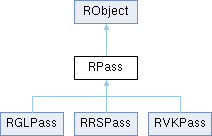
Public Member Functions | |
| ~RPass () noexcept | |
| Destroys the render pass. | |
| CZBitset< RPassCap > | caps () const noexcept |
| Returns the capabilities enabled for this pass. | |
| virtual SkCanvas * | getCanvas (bool sync=true) const noexcept=0 |
| Returns the SkCanvas associated with this pass, if available. | |
| virtual RPainter * | getPainter (bool sync=true) const noexcept=0 |
| Returns the RPainter associated with this pass, if available. | |
| virtual void | setGeometry (const RSurfaceGeometry &geometry) noexcept=0 |
| Sets transformation matrices. | |
| void | resetGeometry () noexcept |
| Resets the geometry to the default RSurface geometry. | |
| const RSurfaceGeometry & | geometry () const noexcept |
| Returns the current geometry for this pass. | |
| std::shared_ptr< RSurface > | surface () const noexcept |
| Returns the destination surface being rendered into. | |
| void | save () noexcept |
| Saves the state of both RPainter and SkCanvas. | |
| void | restore () noexcept |
| Restores the most recently saved state of RPainter and SkCanvas. | |
| Public Member Functions inherited from RObject | |
| RObject ()=default | |
| Constructs a default RObject. | |
Detailed Description
A Ream render pass.
An RPass allows an RDevice to render into an RSurface using either RPainter or SkCanvas, depending on the capabilities requested at creation time (see RSurface::beginPass()).
If you mix both RPainter and SkCanvas commands, make sure to call either getPainter() or getCanvas() first, depending on which API you intend to start using. Failing to do so may lead to synchronization issues, or in some cases, may cause Skia to crash.
Upon destruction, a fence is inserted into the underlying surface RImage to ensure that other threads wait before using the image as a source. Destroying the pass may also trigger flushing of pending Skia commands, depending on the current graphics backend.
Constructor & Destructor Documentation
◆ ~RPass()
|
noexcept |
Destroys the render pass.
Inserts a fence into the backing storage to ensure that subsequent use of the resulting RImage from other threads is properly synchronized. May also flush pending Skia commands.
Member Function Documentation
◆ caps()
|
inlinenoexcept |
Returns the capabilities enabled for this pass.
Indicates whether RPainter and/or SkCanvas is available, based on the flags passed to RSurface::beginPass().
- Returns
- A bitset of enabled RPassCap values.
◆ getCanvas()
|
pure virtualnoexcept |
Returns the SkCanvas associated with this pass, if available.
- Parameters
-
sync Whether to synchronize and prepare the canvas for rendering. Pass false only if you intend to update canvas parameters without rendering.
- Returns
- A pointer to the SkCanvas, or nullptr if SkCanvas is not supported by this pass.
◆ getPainter()
|
pure virtualnoexcept |
Returns the RPainter associated with this pass, if available.
- Parameters
-
sync Whether to synchronize and prepare the painter for rendering. Pass false only if you intend to update painter parameters without rendering.
◆ setGeometry()
|
pure virtualnoexcept |
◆ resetGeometry()
|
noexcept |
Resets the geometry to the default RSurface geometry.
◆ geometry()
|
inlinenoexcept |
Returns the current geometry for this pass.
Defaults to the geometry of the associated RSurface at creation time, unless overridden via setGeometry().
- Returns
- The current RSurfaceGeometry in use.
◆ surface()
|
inlinenoexcept |
Returns the destination surface being rendered into.
- Returns
- A shared pointer to the target RSurface.
◆ save()
|
noexcept |
Saves the state of both RPainter and SkCanvas.
◆ restore()
|
noexcept |
Restores the most recently saved state of RPainter and SkCanvas.
 Cuarzo Software